


Work, Home, School: How to Balance the Relocation Trinity
Updated: Aug 22
Work. Home. School: Balancing the Relocation Trinity Before You Sign a Lease
Landing a Canadian job offer is a massive victory. But the moment the celebration ends, the panic sets in. Your mind immediately starts racing through three critical questions:
Where will I work?
Where will I live?
Where will my kids go to school?
Most newcomers make the mistake of treating these as separate problems.
They look for a house first, map the commute second, and look up local schools last.
That sequence can create expensive and avoidable problems.
In Canada, housing markets, transit systems, and school catchment zones are deeply intertwined.
To prevent relocation burnout, you must balance the Relocation Trinity before you sign a lease. Here is your step-by-step blueprint.

1. Protect the School Catchment First: Reverse the Rental Search
One of the biggest mistakes newcomer families make is searching for housing before understanding school boundaries.
In Canada, your residential address often determines which public school your children can attend. These geographic boundaries are known as school catchment areas, and they can have a significant impact on your family's relocation experience.
If you rent a home even one street outside the catchment area of your preferred school, your children may not be eligible to attend.
The Newcomer Parent Strategy
Step 1: Reverse the Search
Do not start by searching for apartments or rental homes.
Instead, begin by identifying schools that align with your family's educational goals.
You can use school board catchment tools, independent school research resources, or educational guides such as:
Step 2: Create Your Housing Search Grid
Once you have identified two or three preferred schools, review their official catchment maps.
Those catchment boundaries become your new housing search area.
Rather than searching an entire city, you are now focusing on neighbourhoods that support both your housing and educational objectives.
Step 3: Confirm Availability Before Signing a Lease
In rapidly growing newcomer destinations such as Calgary, Edmonton, the Greater Toronto Area, and parts of British Columbia, some schools operate at or near capacity.
Even if you live within the catchment area, enrollment may be restricted, redirected, or subject to waitlists.
Before signing a lease, contact the school board directly to confirm:
Current enrollment availability
Transportation eligibility
Any temporary accommodation or overflow arrangements
AHOM-RMC Tip
The school should influence the housing search—not the other way around.
Families who identify their preferred schools first often avoid costly relocation mistakes, unexpected school assignments, and unnecessary daily commuting challenges later.
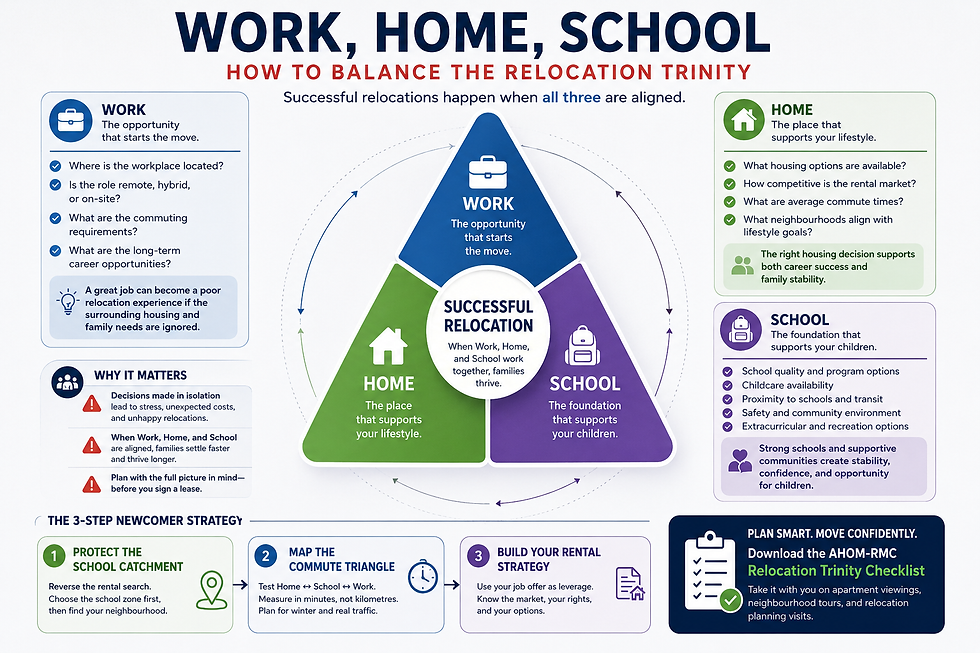
2. The Relocation Trinity Stress Test: Map the Commute Triangle
Once you have identified your preferred school catchment area, the next step is to test how it works with your new workplace.
This creates what we call the Commute Triangle:
🏠 Home to School
🎒 School to Work
💼 Work to Home
Many newcomer families underestimate the amount of time spent moving between these three points every day.
In Canada, distance is measured in minutes—not kilometres.
A 15-kilometre commute in Toronto, Vancouver, or Calgary may appear short on a map but can easily take 45 to 60 minutes during peak traffic periods.
The Newcomer Parent Strategy
Step 1: Test Traffic Virtually
Before signing a lease, test your daily routine.
Using a commute planning tool or mapping application, enter:
Your preferred school
Your workplace
Review travel times during weekday morning and afternoon rush hours.
Pay particular attention to traffic bottlenecks, school zones, highway congestion, and transit transfer points.
The goal is not simply to find a home—it is to understand what daily life will actually look like.
Step 2: Build for Winter, Not Summer
Many newcomers evaluate housing during favourable weather conditions.
Canadian winters tell a different story.
A 20-minute drive in July can become a 40-minute commute during a snowstorm.
When assessing a location, consider:
Winter driving conditions
Snow removal schedules
Public transit reliability
Walking distances to schools and transit stops
Child safety during winter travel
Families relying on public transportation should confirm that school and workplace routes remain practical throughout the year.
Step 3: Measure Family Time - Not Just Commute Time
Every additional minute spent commuting is time taken away from family, recreation, community involvement, and rest.
Before committing to a neighbourhood, ask yourself:
How early will the children need to leave for school?
Who handles drop-off and pick-up responsibilities?
What happens if work runs late?
How will the schedule change during winter weather?
AHOM-RMC Tip
A rental may look perfect online.
A school may have excellent rankings.
A job offer may be exciting.
But if the daily commute creates stress for the entire family, the relocation plan may not be sustainable.
Always test the Commute Triangle before signing a lease.
3. The Pre-Negotiation Rental Framework
You have identified the right school catchment.
You have tested the Commute Triangle.
You have found the neighbourhood that balances work, home, and school.
Now you face the Canadian rental market.
For many newcomers, this is where uncertainty begins.
Without Canadian credit history, rental references, or an established track record, some landlords may hesitate.
The good news is that preparation creates leverage.
The Newcomer Parent Strategy
Step 1: Know Your Market Before You Apply
Before submitting a rental application, understand the local market conditions.
Review current rental listings within your target neighbourhoods and compare:
Monthly rental rates
lawful deposits and advance-payment requirements
Utility responsibilities
Pet policies
Parking availability
Lease renewal terms
Tenant protections and local regulations
The goal is not simply to find a rental.
The goal is to understand your options before entering negotiations.
Step 2: Use Your Employment Offer as a Strength
Your employment offer letter is one of the most valuable documents in your relocation package.
Whenever possible, ensure the letter clearly outlines:
Position title
Annual salary
Employment status
Start date
Many Canadian landlords accept a formal employment offer as proof of income when a newcomer has not yet established Canadian credit history.
A strong employment package can often offset concerns about limited local rental history.
Step 3: Demonstrate Stability
Landlords are looking for reliable, long-term tenants.
Families relocating for work often present a strong application because they are establishing roots in the community.
When appropriate, explain that your housing search was influenced by local schools, commute considerations, and long-term settlement goals.
This demonstrates planning, stability, and commitment to the area.
Step 4: Explore Employer Housing Support
Before finalizing your relocation plans, ask your employer whether relocation assistance is available.
Some employers may offer:
Temporary accommodation
Housing allowances
Relocation stipends
Corporate housing arrangements
Settlement assistance programs
Even a short-term housing solution can provide valuable time to explore neighbourhoods, visit schools, and make informed long-term housing decisions.
AHOM-RMC Tip
Many newcomers focus on securing a rental first and evaluating the neighbourhood later.
Successful relocations work in reverse.
First identify the right school catchment.
Then test the commute.
Then evaluate housing options.
The strongest relocation decisions balance all three parts of the Relocation Trinity:
💼 Work
🏠 Home
🎒 School



Comments