


Seven Questions Employers Should Ask Before Assigning a Relocation
Relocating an employee can appear straightforward at the beginning.
A start date is confirmed. A destination is selected. A moving allowance may be approved. Human Resources sends a few instructions, the employee begins looking for housing, and several external providers become involved.
Then the separate pieces begin colliding.
The employee cannot finalize housing without knowing the arrival date. The arrival date may depend on work authorization. Temporary accommodation costs continue while approvals are pending. A vendor submits an invoice that does not match the original estimate. A spouse has questions outside the employer's policy. Payroll needs information about a taxable benefit. HR becomes the person everyone contacts because no other point of coordination was established.
The problem is not simply that relocation has many tasks. The problem is that those tasks carry different owners, risks, timelines and financial consequences.
Before assigning a relocation, employers—especially small and mid-sized organizations with lean HR teams—should be able to answer seven questions.
1. Who owns the relocation assignment?
Every relocation needs one clearly identified point of accountability.
That does not mean one person must personally perform every task. It means someone must hold the complete view of the assignment: the approved scope, employee requirements, decision points, dependencies, vendors, costs, risks and next actions.
Without a designated lead, responsibility becomes fragmented. HR assumes the housing provider is speaking with the employee. The employee assumes the mover has received the correct date. The hiring manager assumes immigration timing has already been considered. Each party may complete its own task while the overall relocation falls behind.
A defined relocation lead should:
Establish the scope and priorities of the assignment.
Maintain the critical timeline.
Clarify who can authorize decisions and exceptions.
Coordinate communication across the employer, employee and suppliers.
Identify problems before they reach the employee's start date.
Maintain an escalation route when an issue cannot be resolved routinely.
For lean HR teams, this point of accountability is particularly important. Relocation should not quietly become an additional full-time role for a generalist who is also managing recruitment, onboarding, benefits, employee relations and payroll questions.
2. Where are the financial controls?
A relocation budget is not a financial-control system.
The initial estimate may include moving services, travel, temporary accommodation, destination support and a housing allowance. But real assignments change. Arrival dates move. Hotel stays are extended. Employees request exceptions. Vendors add services. Taxes or reimbursements may need to be treated differently than expected.
Employers should know:
Which services and amounts have been approved.
Who may authorize additional spending.
How employee reimbursements will be documented.
How supplier invoices will be checked against agreed pricing.
How costs will be assigned to the correct employee or project.
When reconciliations and client billing will occur.
What financial records will remain available for reporting or audit.
At an early stage, these controls do not require a large finance department. They require defined procedures and appropriate separation of responsibilities. The person preparing or recording a payment should not have uncontrolled authority to create the supplier, approve the charge and release the funds.
Financial visibility protects more than the budget. It allows HR and business leaders to make informed decisions while there is still time to change course.
3. How are vendors managed?
Most relocations involve more than one external provider. Depending on the assignment, the network may include movers, temporary-accommodation providers, real-estate professionals, destination specialists, transportation providers, storage facilities, immigration professionals, tax advisors and local service partners.
Giving the employee a list of names is not the same as managing a vendor network.
Employers should ask:
How providers are selected and verified.
Whether their role and service boundaries are documented.
Which pricing or service standards apply.
Who coordinates changes affecting multiple vendors.
How service problems and complaints are escalated.
How invoices are validated.
Whether the employer can see the status of outstanding vendor actions.
Vendor management is where many apparently minor gaps become costly. A delayed housing confirmation can extend a hotel booking. A change in immigration timing can affect travel, shipment and lease dates. A mover may perform exactly as instructed while still arriving at the wrong point in the employee's broader timeline.
The relocation lead must connect supplier activity to the complete assignment—not merely pass contact information from one party to another.
4. Who handles confidential information?
Relocation files can contain highly sensitive personal and business information.
Employee and family names, birth dates, passport details, addresses, financial documents, compensation information, immigration records, school information, health-related accommodation needs and travel schedules may all enter the process. Employers may also share internal data about assignments, reporting lines, project locations and start dates.
Before information is collected, the parties should understand:
What information is necessary.
Why it is being collected.
Who is authorized to access it.
How it will be transmitted and stored.
Which information may be shared with each supplier.
How long records will be retained.
What happens when access is no longer required.
How a privacy or security concern will be escalated.
The correct question is not, “Do you have a privacy policy?” It is, “How does information move through this particular relocation?”
A policy matters, but controlled access, careful document handling and clear supplier boundaries determine what happens in practice.
5. Where do regulated specialists enter?
Relocation frequently intersects with immigration, tax, legal, insurance and other regulated matters. A relocation coordinator may identify a milestone, organize information and keep the assignment moving, but that does not make the coordinator qualified to provide regulated advice.
Employers should know:
Which questions require a licensed or otherwise qualified professional.
Who is responsible for making the referral or engagement.
Whether the specialist advises the employer, the employee or both.
How specialist timelines affect travel, housing and onboarding.
What information can be shared with the broader relocation team.
Who communicates the operational impact without reinterpreting professional advice.
This boundary should be visible from the beginning. It protects the employer and employee while allowing the relocation plan to incorporate the specialist's milestones.
Good coordination does not blur professional roles. It connects them.
6. Can the delivery structure scale?
An approach that works for one straightforward move may fail when several employees relocate at once—or when one assignment becomes unusually complex.
Employers should ask what changes when:
Multiple employees share the same deployment date.
Moves involve several provinces or countries.
Housing inventory is limited.
A project schedule changes suddenly.
An executive or specialized employee requires a higher level of discretion.
Family, accessibility or schooling requirements add complexity.
A peak period creates more cases than the normal team can carry.
Scalability is not demonstrated by saying, “We can handle any volume.” That is marketing, not an operating answer.
A credible scaling model explains how caseloads are allocated, when additional coordinators or regional resources are assigned, how quality is monitored, and how the employer's reporting remains consistent as volume increases.
Capacity should be measured by complexity, geography, urgency and service requirements—not only by the number of open files.
7. Does the provider understand both domestic and global mobility?
Domestic and international relocations are not interchangeable, but neither should they be treated as unrelated disciplines.
A move between Canadian provinces may still involve different housing conditions, healthcare transitions, taxation considerations, licensing requirements, school systems and travel distances. An international assignment adds borders, immigration, customs, global tax considerations, cultural adjustment and country-specific timelines.
Employers should look for evidence that a provider can distinguish among:
Local and intercity moves.
Interprovincial employee relocations.
Canada–United States mobility.
International arrivals and departures.
Executive and family relocations.
Project and workforce deployments.
Temporary assignments and permanent transfers.
Understanding global mobility does not mean claiming direct coverage in every country. It means knowing how to plan across corridors, coordinate appropriate regional and regulated specialists, identify destination-specific risks and state honestly where delivery capacity exists.
For employers, that honesty is more valuable than a map covered in unsupported location pins.

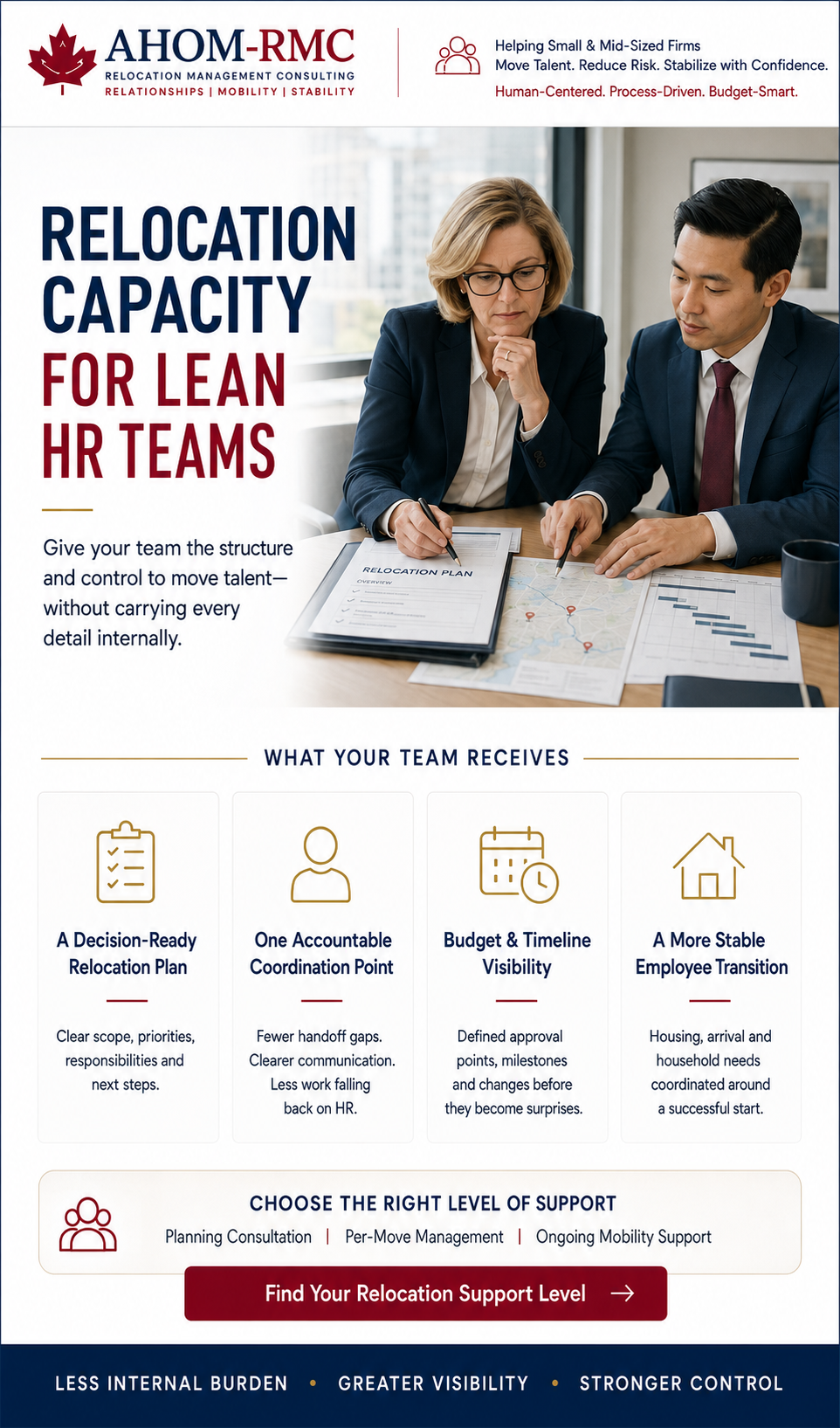
What a lean HR team should receive
A lean HR team does not need to surrender control of the employee relationship. It needs a relocation structure that prevents every operational detail from falling back on HR.
At a minimum, the employer should receive:
A decision-ready relocation plan.
One accountable coordination point.
Defined roles, responsibilities and escalation paths.
Budget, approval and timeline visibility.
Coordinated vendor activity.
Appropriate privacy and information-handling controls.
Clear entry points for regulated specialists.
Housing, destination and household support aligned with the employee's work requirements.
A delivery structure capable of scaling with the assignment.
The employer retains policy authority, approvals and visibility. The relocation provider carries the structured coordination needed to move the assignment forward.
Relocation capacity without building everything internally
Small and mid-sized organizations should not have to create a permanent global mobility department before they can relocate talent responsibly.
They do, however, need to know that every critical function has been considered and assigned.
AHOM-RMC provides planning consultations, per-move management and ongoing mobility support for organizations that need stronger relocation capacity without carrying every operational detail internally. Our model connects relocation strategy, financial administration, housing and destination support, vendor coordination, employee and family readiness, and qualified specialist involvement within one accountable path.
Before the next employee accepts a move, ask the seven questions.
The answers will reveal whether the relocation is truly ready to begin—or whether HR is about to inherit another unmanaged project.


Comments