


Structure & Coordination : Why Structured Relocation Matters
A project rarely fails because of a single decision. It slows down because of many small, disconnected ones. An employee accepts a housing option that is technically available but poorly located. An arrival date shifts without anyone adjusting onboarding. A team member becomes unsettled and starts looking elsewhere. None of these events feel dramatic on their own, yet together they can quietly erode a project's timeline, budget, and workforce stability.

This is why structure matters.
When relocation is treated as a single administrative task, rather than a coordinated part of workforce planning, organizations lose visibility into the very factors that determine whether people arrive ready, stay settled, and remain productive. A structured relocation approach connects housing, commute, timing, and workforce planning into one coordinated process, so that project execution is supported rather than left exposed to avoidable disruption.
Housing and Corridor Alignment
Housing is frequently discussed as an availability problem. In practice, it is more often a fit problem. An employee may find a place to live that is available, but that does not mean it works. It may be too far from the worksite, unsuited to shift schedules, disconnected from reliable transportation, or unsuitable for a household with family needs.
This is what a corridor-fit approach is designed to address. Housing, commute, worksite location, shift timing, and household composition need to work together as one picture, not as separate decisions made at different times by different people. When corridor alignment is considered early, employers can identify realistic housing options before an offer is accepted, rather than discovering a mismatch after an employee has already relocated.
Poor corridor fit tends to surface as recurring, avoidable costs: longer commutes that affect attendance and morale, extended temporary accommodation because permanent housing did not work out, or turnover among employees who never fully settled into the assignment. A structured approach treats housing and commute as project variables, planned alongside timelines and budgets, not as a personal matter left entirely to the employee to solve after arrival.

Workforce Continuity in Relocation
Every relocation is also a continuity decision.
When a project depends on specific people arriving, staying, and performing consistently, workforce continuity becomes a direct input into project delivery, not a separate human resources concern.
Continuity risk shows up when arrivals are staggered without a clear plan, when family or household needs are not considered until after a move is already underway, or when there is no consistent point of contact for employees navigating an unfamiliar community. Any of these gaps can lead to early departures, extended vacancies, or a team that never reaches full operating capacity when the project needs it most.
A structured relocation strategy treats continuity as something to plan for from the start. This includes realistic arrival sequencing, settlement support that extends beyond the first weeks, and attention to the household factors, such as family stability and community adjustment, that influence whether an employee remains through the length of an assignment. Protecting continuity is not about eliminating every change. It is about building enough structure that the workforce can absorb change without losing momentum.
Operational Visibility
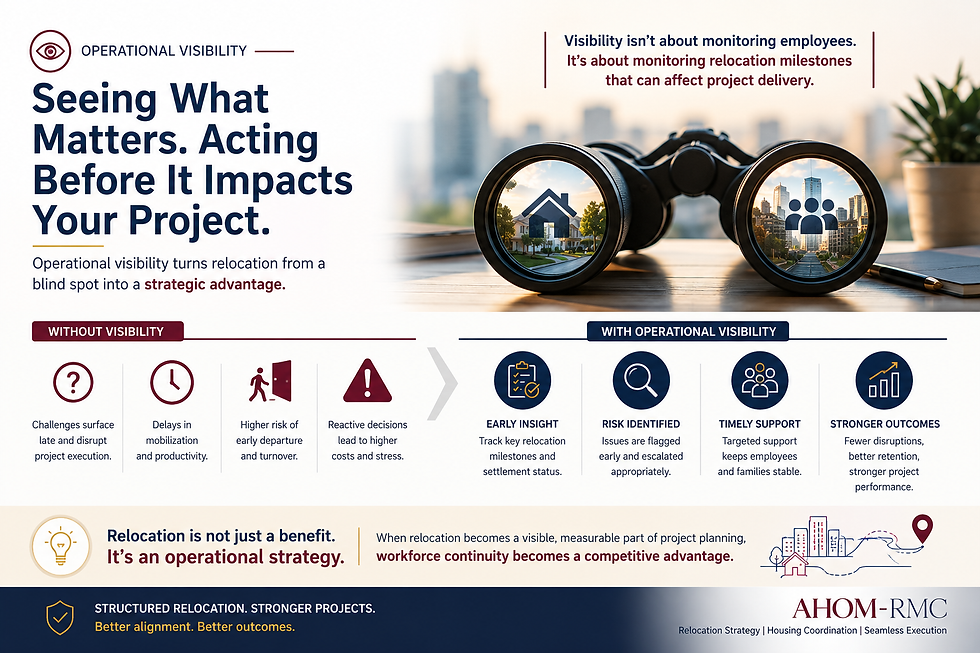
Perhaps the most overlooked element of structured relocation is operational visibility.
Most organizations have strong visibility into project budgets, schedules, staffing levels, and construction milestones. What they often lack is visibility into the practical realities that determine whether relocated employees are truly ready to perform.
Has suitable housing been secured?
Has the family settled?
Is the daily commute sustainable?
Are there emerging issues that could affect attendance, productivity, or long-term retention?
Without that visibility, challenges often surface only after they begin affecting the project—when an employee reports a problem, a mobilization is delayed, productivity declines, or a valued worker decides to leave.
A structured relocation program closes this gap by introducing consistent coordination, regular status reporting, and clear relocation milestones throughout the employee's transition. Potential risks can be identified early, escalated appropriately, and addressed before they become operational issues.
Operational visibility provides project leaders with what they need most: timely, relevant information that supports better decision-making. Rather than reacting to unexpected disruptions, employers gain the ability to anticipate challenges, coordinate appropriate support, and maintain workforce continuity.
When relocation becomes a visible, measurable component of project planning, it shifts from being an individual administrative task to a strategic operational function that contributes directly to project performance.
Bringing It Together
Housing, commute, timing, and workforce coordination are not separate relocation tasks. They are connected inputs into project execution. Mobilization readiness determines whether people arrive on time and prepared. Housing and corridor alignment determine whether that arrival is sustainable day to day. Workforce continuity determines whether the team stays intact through the length of the assignment. Operational visibility determines whether employers can see and respond to problems before they escalate.
When these elements are managed independently, or left to employees to figure out on their own, small issues accumulate into project risk. When they are structured and coordinated from the beginning, relocation becomes a source of stability for the project rather than a variable working against it.
AHOM Relocation Management Company helps organizations bring this structure to project-based workforce relocation, connecting mobilization, housing, continuity, and visibility into one coordinated approach.
Planning a project that depends on relocating people successfully? Connect with AHOM-RMC to build a structured relocation approach that supports your workforce and your project timeline.
AHOM-RMC supports:
Project workforce mobilization planning
Housing and corridor-fit assessment
Workforce continuity and retention planning
Relocation status reporting and operational visibility


Comments